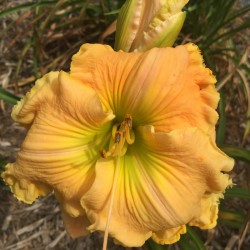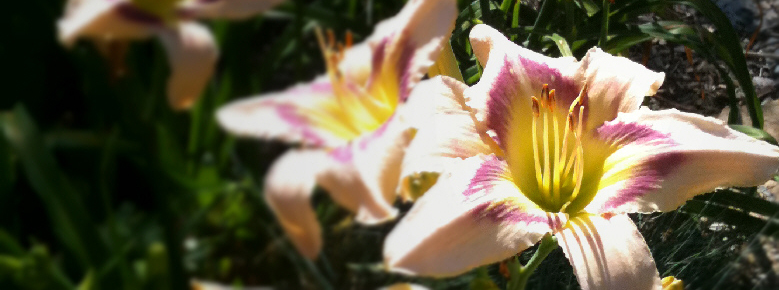

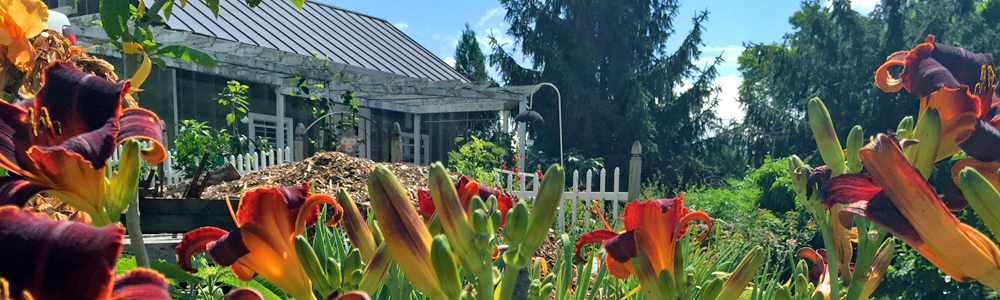
Hardy throughout the US, daylilies are found
in nearly every garden. I couldn't imagine mine without them.
Our garden was hit hard by the easter frost, but I am happy to see that
almost all the plants appear to be coming around again and putting
on new growth. In particularly, the daylilies leaves turned a sickly
shade of gray but now, 3 weeks later, not only have put on growth,
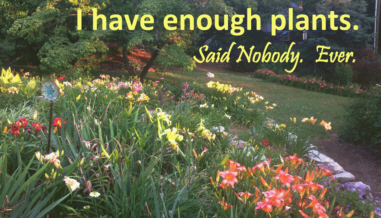
they are beginning to bud out already. I can't have enough of them
in my garden!
Propagation can be divided into two types:
- Multiplying the same variety
- Creating a new variety - Hybridization
More of the Same
Probably the most known and common method is to dig up the root ball
and divide the rhizomes. This can be done most anytime the plant
is not in bloom. Ok, I admit, I have dug and divided them while
in bloom but I can't think of any reputable garden source that
recommends this method! Generally, most sources suggest
tackling this task in fall or early spring.
Another, lesser known, method is to harvest the proliferations.
After the daylilies have finished blooming and before the stalks
turn comletely brown, it's a good time time to check the scapes
for proliferations. Cut any you find with about 2 inches of stalk
remaining and pot them up. Don't have any pots around? Put
the 'baby' in a glass of water. Be sure to label them so you'll know
"who's who" in the spring.
Keep them in a sunny
window for the winter before transplanting them back into the garden
come spring. This proliferation will be an identical twin to the
parent plant.
In just a little time, you have increased your supply of lovely daylilies for
your own garden or as gifts to your family and friends.

Something different
One important thing to know about daylily seeds: seeds are NEVER
the same as the parent plant.. Even seeds resulting from a plant
that was fertilized with it's own pollen will not produce plants
that are identical to the parent plant. While the likelyhood is
that the plant will be quite similar, usually it will not bloom
as well and sometimes the bloom will be completely different than
the parent.
In this lies the fun of growing daylilies from seed, you never
know what you may get!
While professional daylily hybridizers go through a very specific
selection process when deciding which daylilies to cross, when
just starting out, there is basically only one thing you should
know:
There are 2 types of daylilies, diploids and tetraploids. They
are very hard to tell apart and pollen from one type will not set
seed on the other. If you do not know which type you have, plan
on crossing several different varieties in case some turn out to
be different types and don't set seed.
Typically, the seeds take between 40 and 60 days to mature to the
point where they can be harvested. You can tell when it's time
to harvest, when the seed pods begin to split open. Sometimes I
squeeze the pod gently to see if it is ready to split. This is
OK, but remember that seeds harvested too early will probably not
germinate.
Seeds can be planted directly in the ground, or started in either
flats or pots and later transplanted. Remember that seeds require
fairly warm soil temperatures for good germination.
See our March 2007 Newsletter
for more information about starting seeds.
|